

Let’s be honest. You didn’t start your plumbing, cleaning, electrical, or HVAC business to become a marketing expert. You started it because you’re good at what you do, and you want more customers to find you.
The problem? Your competitor down the street keeps popping up on Google every time someone in your area types “plumber near me” or “electrician in [your city].” And you? You’re nowhere to be seen. The truth is, to rank your local service business on Google, you don’t need a big ad budget, you need the right strategy. And that’s exactly what this guide is about.
Here’s the good news: ranking your local service business on Google doesn’t require a massive ad budget. It requires the right strategy, and that’s exactly what this guide is about.
By the time you finish reading, you’ll know every step needed to get your business showing up where it matters most: the top of Google Search and Google Maps.
The Proven Steps to Rank Your Local Service Business on Google
Before we dive into tactics, let’s talk about why this matters so much.
Think about the last time you needed a plumber, a roofer, or a house cleaner. What did you do? You probably pulled out your phone and searched on Google. Your customers do the exact same thing, every single day.
Here’s what the numbers tell us:
| Statistic | What It Means for You |
|---|---|
| 46% of all Google searches have local intent | Nearly half of all searches are people looking for local businesses. |
| 76% of people who search locally visit a business within 24 hours | These are hot leads ready to buy. |
| 84% of Google Maps discoveries come from keyword searches | People find you by searching for what you do, not your business name. |
| 87% of customers won’t consider a business with low or no ratings | Reviews are essential for building trust and winning customers. |
| Organic SEO delivers an average 400% ROI for small businesses | It costs far less than paid ads and continues generating leads long-term. |
The point is clear: if you’re not on page one of Google, you are invisible to most of your potential customers. And invisible means no calls, no bookings, and no growth.
Understanding How Google Decides Who Ranks Locally
Google uses three core factors to decide which local businesses show up in search results. Understanding these is the foundation of everything that follows.
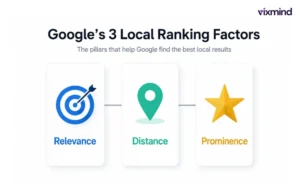
1. Relevance, Does Your Business Match What the Person Is Searching For?
Relevance is about how well your business listing matches a customer’s search. If someone types “emergency HVAC repair near me,” Google looks at your website, your Google Business Profile, your service list, and your content to decide if you’re relevant.
The more clearly you tell Google what you do and where you do it, the more relevant you appear.
2. Distance, How Close Are You to the Searcher?
This one is partly out of your control, you can’t move your business. But you CAN make sure Google knows exactly where you serve. Listing your service areas clearly on your website and Google Business Profile helps you rank in more locations.
3. Prominence, How Well-Known and Trusted Is Your Business?
Prominence is the factor you can influence the most. It’s based on your reviews, your backlinks, your mentions across the web, and the overall authority of your website. The more well-known and trusted you appear online, the higher Google ranks you.
Step 1: Build (or Fix) a Website That Google Can Actually Rank
Your website is your most important asset. Not just for customers, for Google. Without a solid website, everything else in this guide becomes much harder.
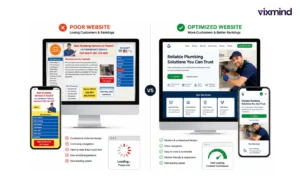
Here’s what a Google-friendly service business website needs:
Create a Dedicated Page for Every Service You Offer
Don’t list all your services on one page. Give each service its own page. A plumber should have separate pages for “drain cleaning,” “water heater installation,” “emergency plumbing,” and so on. This tells Google exactly what you offer and helps you rank for each individual service.
Build Location-Specific Pages
If you serve multiple cities or areas, create a unique page for each one. A page titled “Electrician in Sydney” with content specific to that area will outperform a generic “areas we serve” page every single time.
Make Sure Your Site Is Fast and Mobile-Friendly
More than three-quarters of local searches happen on mobile devices. If your site loads slowly or looks broken on a phone, Google will rank it lower, and customers will leave within seconds.
Quick checks to do right now:
- Test your site speed at Google PageSpeed Insights
- Open your website on your phone and scroll through it
- Make sure your phone number is clickable (tap-to-call)
- Ensure your contact form works on mobile
Add Your NAP Information on Every Page
NAP stands for Name, Address, Phone Number. This information must appear consistently on every page of your website, in your Google Business Profile, and across every directory listing online. Even a small discrepancy, like “St.” vs “Street”, can confuse Google and hurt your ranking.
At Vixmind, we build custom websites for local service businesses that are designed from the ground up to rank on Google. Every page is structured, fast, and optimized for local search, so you start getting calls, not just traffic. Learn how we do it → vixmind.com
Step 2: Optimize Your Google Business Profile (This Is Non-Negotiable)
Your Google Business Profile (formerly Google My Business) is the single most powerful free tool available for local service businesses. It’s what shows up in the map results at the top of Google when someone searches for your service.
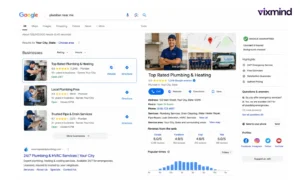
Here’s how to get the most out of it:
Claim and Verify Your Profile
If you haven’t already, go to business.google.com and claim your listing. Google will send a verification code to your business address. This step is free and takes about 10 minutes.
Fill Out Every Single Section
Businesses with complete and accurate information are far more likely to show up in local search results. Don’t skip anything.
| Profile Section | Optimization Tip |
|---|---|
| Business Name | Use your exact legal business name and avoid keyword stuffing. |
| Primary Category | Select the most accurate category for your business (e.g., Plumber, Electrician). |
| Services | Add every service you offer and include clear, detailed descriptions. |
| Service Areas | List all cities, towns, suburbs, and neighborhoods you serve. |
| Business Hours | Keep hours accurate and update them for holidays or special events. |
| Business Description | Write a detailed description that naturally explains your services and location. |
| Photos | Upload 10–20 high-quality photos of your team, projects, vehicles, and workspace. |
| Phone & Website | Ensure your phone number and website URL match your website and other listings exactly. |
Post Regular Updates
Google rewards active profiles. Post updates, special offers, seasonal tips, or recent project photos at least once a week. Think of it like a social media profile that directly influences your ranking.
Use Google’s Q&A Feature
Add questions and answers to your profile proactively. Think about what customers commonly ask: “Do you offer same-day service?” “Do you serve [city]?” “Are you licensed and insured?” Answering these builds trust and helps Google understand your business better.
Step 3: Get Google Reviews (More Than Your Competitors)
If you do one thing after reading this article, make it this: ask every satisfied customer to leave you a Google review.
Reviews are one of the strongest ranking signals Google uses for local businesses. More reviews, higher ratings, and fresh reviews all push your business up in the local pack.
How to Get More Reviews Without Being Pushy
Getting reviews doesn’t need to be awkward. Here are a few simple ways to do it:
- Send a follow-up text or email after completing a job with a direct link to your Google review page
- Add a QR code to your invoice or business card that links directly to your review form
- Ask in person right after the job when the customer is happiest: “If you were happy with our work today, a quick Google review means the world to us”
- Respond to every review, good and bad. This shows Google and future customers that you’re engaged and professional
Pro tip: Aim for a minimum 4.8-star rating. Industry data shows that businesses below this threshold rarely break into the top three local results, regardless of other factors.
Step 4: Use the Right Keywords on Your Website
Keywords are the words and phrases your potential customers type into Google when they need your services. Using the right ones on your website is how Google connects their searches to your business.
Focus on Intent-Based, Local Keywords
Don’t just target “plumber.” Target phrases that show real buying intent with a location attached:
| Generic Keyword | Location-Focused Keyword |
|---|---|
| plumber | emergency plumber in [city] |
| electrician | licensed electrician near [suburb] |
| HVAC repair | AC repair same-day [city] |
| cleaning service | house cleaning service [city] |
| junk removal | affordable junk removal [city] |
These longer, more specific phrases are called long-tail keywords. They have less competition than broad terms, and the people searching them are ready to hire right now.
Where to Place Your Keywords
Once you know your keywords, use them in the right places:
- Page title (the tab name in your browser)
- H1 heading (the main headline on the page)
- First paragraph of your content
- Meta description (the snippet Google shows in search results)
- Image alt text (the description of your photos)
- URL slug (e.g., yoursite.com/plumber-sydney)
Don’t repeat keywords unnaturally. Write like a human, for your customers first, and Google second.
Step 5: Build Local Citations and Directory Listings
A “citation” is any mention of your business name, address, and phone number on another website. The more consistent and widespread these are, the more Google trusts your business is legitimate.
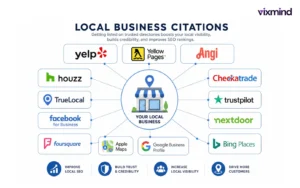
Key Directories to List Your Business On
| Country | Key Business Directories |
|---|---|
| United States | Yelp, Angi, HomeAdvisor, Thumbtack, Better Business Bureau, Houzz |
| Canada | Yellow Pages Canada, HomeStars, Houzz, Yelp Canada, Canada411 |
| Australia | TrueLocal, Hipages, ServiceSeeking, Yellow Pages AU, Oneflare |
| United Kingdom | Checkatrade, Rated People, TrustATrader, Yell.com, MyBuilder |
| All Countries | Google Business Profile, Facebook, Bing Places, Apple Maps |
Make sure your business name, address, and phone number are exactly the same on every listing. Even small inconsistencies can weaken your local SEO.
Step 6, Create Helpful Content That Answers Customer Questions
One of the most overlooked strategies for local service businesses is blogging. Publishing helpful articles on your website builds your authority with Google over time — and it keeps bringing in new customers for free, month after month.
You don’t need to write essays. Simple, useful content like this works extremely well:
- “How to Know When Your Hot Water System Needs Replacing” (for plumbers)
- “5 Signs Your Electrical Panel Needs an Upgrade” (for electricians)
- “How Often Should You Service Your Air Conditioner?” (for HVAC)
- “What’s Included in a Professional End-of-Lease Clean?” (for cleaners)
These articles target the questions people are already searching for. When your content answers those questions better than anyone else, Google ranks it, and those readers become your customers.
Make Your Content Locally Specific
Instead of writing “How to Prepare Your AC for Summer,” write “How to Prepare Your AC for Summer in Brisbane.” The local angle makes your content more relevant to your target audience AND more likely to rank in that specific location.
Step 7: Get Local Backlinks to Build Authority
A backlink is when another website links to yours. Think of it as a vote of confidence. The more quality websites that link to you, the more authoritative Google considers your site.
For local service businesses, here’s where to focus:
How to Get Local Backlinks
- Local Chamber of Commerce — Most will list member businesses with a website link
- Local business directories — As mentioned above, these also count as links
- Partner businesses — Team up with complementary local businesses (a plumber can partner with an electrician, an HVAC tech, a property manager) and link to each other
- Sponsor local events — Many event pages will include a link to your business website
- Local news mentions — Getting featured in a local newspaper or community blog is extremely valuable
- Supplier websites — Some product manufacturers feature trusted local contractors on their websites
You don’t need hundreds of backlinks. A handful of quality, locally relevant links can make a significant difference in your rankings.
Common Mistakes That Are Killing Your Local Google Ranking
Before you go, let’s quickly cover what NOT to do. These are the mistakes we see local service businesses make all the time.
| Common Mistake | Why It Hurts Your Local SEO |
|---|---|
| Ignoring Your Google Business Profile | It’s one of the most important local ranking factors and costs nothing to optimize. |
| Not Asking for Reviews | Positive reviews build trust and help you compete against businesses with stronger reputations. |
| Using an Outdated or Slow Website | Slow-loading, non-mobile-friendly websites can reduce rankings and drive visitors away. |
| Keyword Stuffing | Overusing keywords creates a poor user experience and may negatively impact search visibility. |
| Inconsistent NAP Information | Differences in your business name, address, or phone number can weaken local trust signals. |
| No Location-Specific Pages | Search engines may struggle to understand which cities, suburbs, or service areas you target. |
| Relying Only on Paid Ads | Paid traffic stops when your budget ends, while SEO can continue generating leads over time. |
How Long Does It Take to Rank on Google?
This is the question everyone asks, and the honest answer is: it depends.
In general, here’s a realistic timeline for a local service business doing everything in this guide consistently:
| Timeline | What to Expect |
|---|---|
| 0–30 Days | Google begins indexing your website updates and Google Business Profile improvements. Early visibility gains may start to appear. |
| 1–3 Months | You may start ranking for less competitive local keywords while your Google Business Profile gains momentum. |
| 3–6 Months | Noticeable improvements in rankings for important service and location-based search terms. |
| 6–12 Months | A consistent flow of organic traffic and leads with the potential to achieve first-page rankings for primary keywords. |
| 12+ Months | Established local authority, stronger brand recognition, and the possibility of maintaining top local search positions. |
SEO is not a quick fix, but unlike paid ads, the results compound over time. Once you’re ranking, you get free leads month after month without spending a single dollar on advertising.
You Don’t Have to Figure This Out Alone
Look, running a service business is already a full-time job. You’re juggling jobs, managing staff, handling customer calls, and trying to grow. Learning SEO on top of all that is a lot to ask.
That’s exactly why Vixmind exists.
We build custom websites for local service businesses, plumbers, electricians, HVAC contractors, cleaners, junk removal companies, and more, that are designed from day one to rank on Google. We handle the website design, on-page SEO, page structure, and everything else that goes into a site that actually brings in calls.
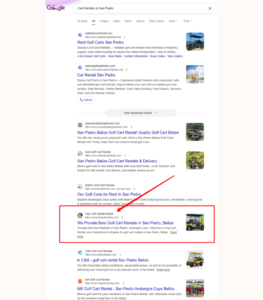
Our clients are getting found by customers in their city every single day, without running a single ad.
If you’re tired of watching your competitors rank above you while you’re doing better work, it’s time to fix that.
Book a free strategy call with Vixmind → vixmind.com
Frequently Asked Questions
Can I rank on Google without paying for ads?
Yes, absolutely. Paid ads can get you quick visibility, but organic SEO through your website and Google Business Profile is what gives you sustainable, long-term rankings. Many local service businesses generate the majority of their leads through organic Google rankings alone.
How important is my Google Business Profile?
Extremely important. It’s one of the most powerful ranking factors for local search and it’s completely free. An optimized profile directly impacts whether you appear in Google Maps and the local pack at the top of search results.
Do I need to blog to rank on Google?
Not necessarily at first, but publishing helpful local content is one of the best long-term strategies. It builds your website’s authority and helps you rank for the questions your customers are already searching.
How many Google reviews do I need?
There’s no magic number, but more is always better. Focus on getting reviews consistently, a steady flow of new, genuine reviews is more valuable than a burst of 50 reviews at once. Aim for a 4.8-star average or higher.
What’s the difference between local SEO and regular SEO?
Regular (or “organic”) SEO focuses on ranking your website in standard search results. Local SEO specifically targets location-based searches, the map results, “near me” searches, and city-specific keywords that are most relevant for service businesses with a physical presence or service area.
Written by the Vixmind team, helping local service businesses across the USA, Canada, Australia, and the UK get found on Google and win more jobs.